If the idea of a dental exam makes your shoulders rise a little, you are not alone. Many people picture the same thing: a quick look, a poke here and there, a list of what is wrong.
More Than Fixing Teeth: What a Whole-Body Dental Exam Actually Looks For
If the idea of a dental exam makes your shoulders rise a little, you are not alone. Many people picture the same thing: a quick look, a poke here and there, a list of what is wrong. Maybe you have had visits that felt rushed, or where you left with a treatment plan but not much understanding of why. I want to offer you a different picture, because a comprehensive exam in our office is a calmer, more thorough, and more hopeful experience than you might expect.
When you come to see us, we are not just checking for cavities. We are getting to know your whole chewing system and, through it, getting to know you. Here is what that actually looks like, step by step, so you know exactly what to expect before you ever sit in the chair.
We start by listening
Before we look at anything, we want to hear from you. What brought you in? How are you feeling overall? Are there things that bother you, like a tender jaw, sensitivity, headaches, or trouble sleeping? Are there parts of your smile you wish were different? There are no wrong answers here, and nothing you share will be met with judgment.
This part matters more than people realize. It is my belief that dentistry should be a partnership, and a partnership begins with understanding your goals. When I know what you are hoping for, I can look at everything that follows with your priorities in mind, not a one-size-fits-all checklist.
The joints and muscles
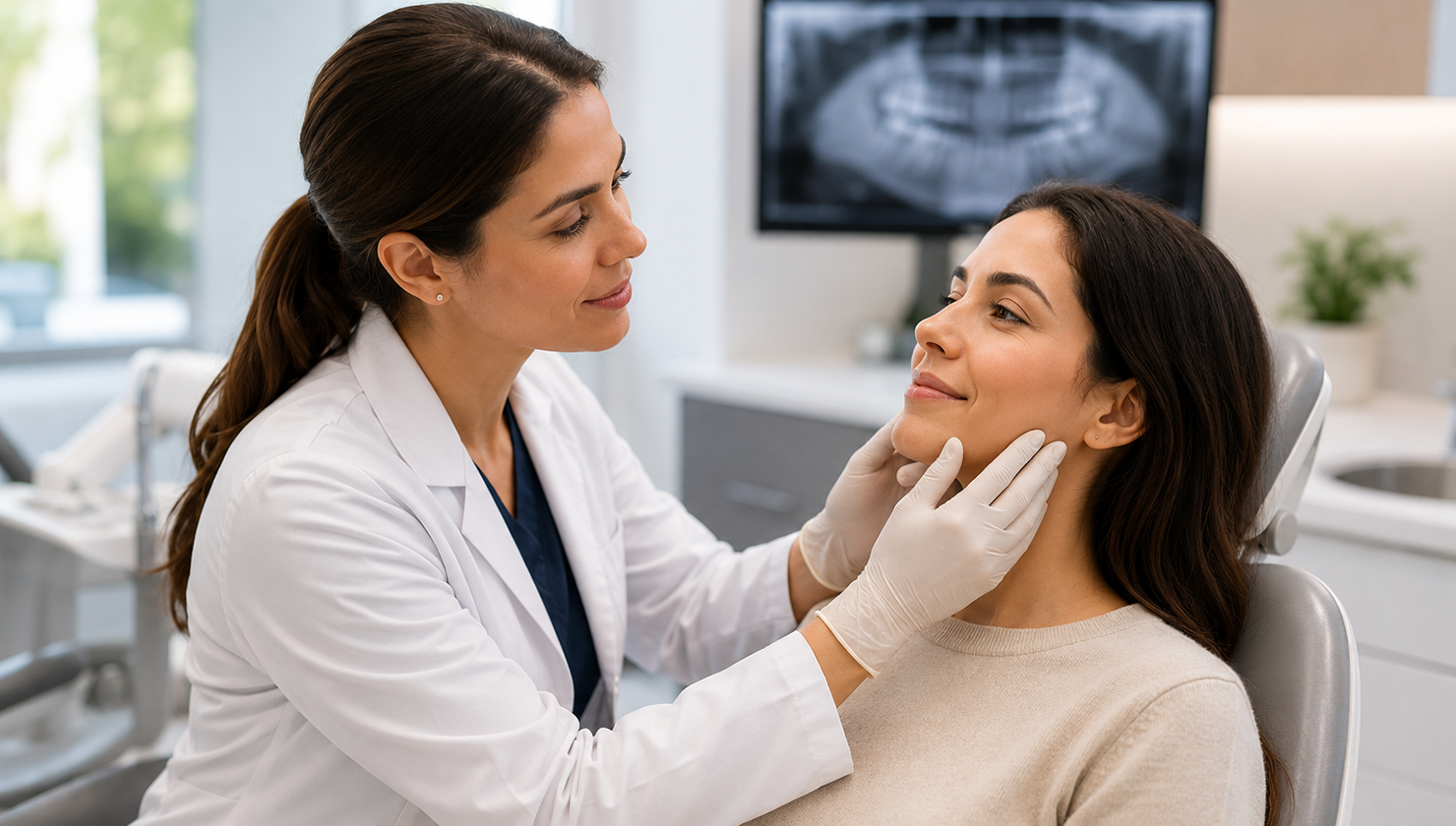
From there, we begin looking at the whole system, and that includes parts of you that many exams skip entirely. We check the joints of your jaw and the muscles around them. These are the hard workers of your chewing system. They move every time you talk, eat, and swallow, and they often keep working through the night without you knowing.
We feel for tenderness, listen for clicking or popping, and notice how smoothly your jaw opens and closes. When these joints and muscles are under strain, the effort has to go somewhere, and it can show up as soreness, tightness, or headaches. Looking here helps us understand discomfort that might never seem connected to your mouth at first glance.
The way your teeth come together
Next we look at your bite, which is simply the way your upper and lower teeth meet. This is one of the most important and most overlooked parts of a thorough exam. When your bite is balanced, the forces of chewing are shared evenly. When it is off, certain teeth carry more than their share, and over time that can lead to wear, sensitivity, cracks, or strain on the muscles and joints we just talked about.
Your bite is where so many pieces of the puzzle connect. Understanding it often explains things you have lived with for years and gives us a clear place to begin.
The jaw, gums, and bone
We also look at the foundation that holds everything in place. The jaw, the gums, and the supporting bone are the ground your teeth stand on, and their health affects far more than your mouth.
We gently check your gums for signs of inflammation, because gum health is closely tied to your overall health and the wellbeing of your whole body. We look at the bone that supports your teeth to make sure that foundation is strong. Healthy gums and bone are quietly essential, and caring for them is one of the most meaningful things we can do for your long-term health.
The teeth themselves
Of course, we look closely at your teeth too. We check for decay, wear, old work that may be breaking down, and anything that needs attention. But notice where this falls in the process. By the time we examine individual teeth, we already understand the whole system they live in. That context changes everything. A worn tooth means something different when we know your bite is uneven or your muscles are working overtime, and it lets us treat the cause rather than only the symptom.
We look for the why
This is the heart of how we practice. Most offices are very good at finding what is wrong and fixing it. We want to do that too, but we also want to understand why it is happening in the first place. Why is this tooth wearing down? Why do these headaches keep returning? Why does this area of the gums keep flaring up?
When we find the why, we can do two powerful things. We can address what is bothering you now, and we can help prevent it from happening again or getting worse. That is a very different goal than patching one problem and waiting for the next. It is also where some of the tools we love come in, like screening your saliva for pH and nitric oxide, which give us clues about your health that we simply could not see otherwise.
We share what we see, and we do it together
After we have gathered the full picture, we sit down and talk through what we found in plain language. No jargon without explanation, no rushing, no pressure. My job is to bring my clinical expertise and give you honest feedback about what I am seeing, so that you can understand it and trust the choices we make together.
I want to say this clearly, because I know it is on many people’s minds. I do not diagnose treatment that I believe is unnecessary. I will never shame you, scold you, or make you feel bad about your circumstances. Wherever you are starting from is simply where we start. From there, we build a plan that is realistic for you, paced for your life, and aimed at moving you toward optimal health.
Why all of this is worth your time
You might be wondering why we go to this much trouble when a faster exam exists. The answer is that a quick look can fix a tooth, but it cannot tell you why you keep ending up in the chair. Looking at the whole chewing system lets us connect the dots, ease the things you have been living with, and help you avoid bigger problems down the road. It is care designed around your whole health, starting with your mouth.
It is also simply a kinder experience. When you understand what is happening in your own body, the anxiety tends to ease. Knowledge really is power, and our hope is that you leave each visit knowing more than when you walked in.
What to expect when you come in
So when you visit us for a comprehensive exam, expect to be heard first. Expect us to look at the joints, the muscles, your bite, the jaw, the gums, the bone, and the teeth, as one connected system. Expect a real conversation about what we found and what it means for you. And expect to be treated as an individual with your own goals and circumstances, never as just a number.
My hope for you is that you walk out feeling cared for, informed, and hopeful about the path ahead. That is what a whole-body dental exam is really for, and we would be honored to welcome you in for one.
Book a Consultation
It’s easy and free!